

Products are no longer presented only against a beautiful or neutral background. They are increasingly placed within environments that make something felt: origin, handwork, ritual, history or material awareness.
During Milan Design Week 2026, it became clear how presentation is shifting from styling towards presence. Not only through large installations, but especially through moments in which a product became part of an action, a sound, a scent or a ritual.

At Alcova, in Casa delle Suore, Masami Okada for Atelier Noritake sat in deep concentration, painting porcelain by hand. That image stayed with me because the object was not shown only as a finished product. The act of making became part of the presentation. The vase carried time, concentration and attention, visible in its surface.

Also at Alcova, Jose Miguel Schnaider brought such a moment together with The Wedding for Sten Studio. The space smelled of honey, candles were burning, flowers and ornaments were arranged like a carefully built ritual between marble objects. A woman played the harp in the acoustic space. The attention shifted from looking to experiencing. It was not only about the objects themselves, but about scent, sound, material and ceremony as part of the same presentation.

At Galleria Rossana Orlandi, a carefully placed floral arrangement lay on the floor. A woman moved slowly around it with a portable sound object made of metal tubes. As she gently struck the tubes with a small stick, clear, chiming tones filled the room. Within the intensity of the design week, a fragile moment of focus suddenly appeared. The flowers did not function as decoration, but as part of a ritual action. They shifted the attention from product to presence, from looking to feeling and listening.

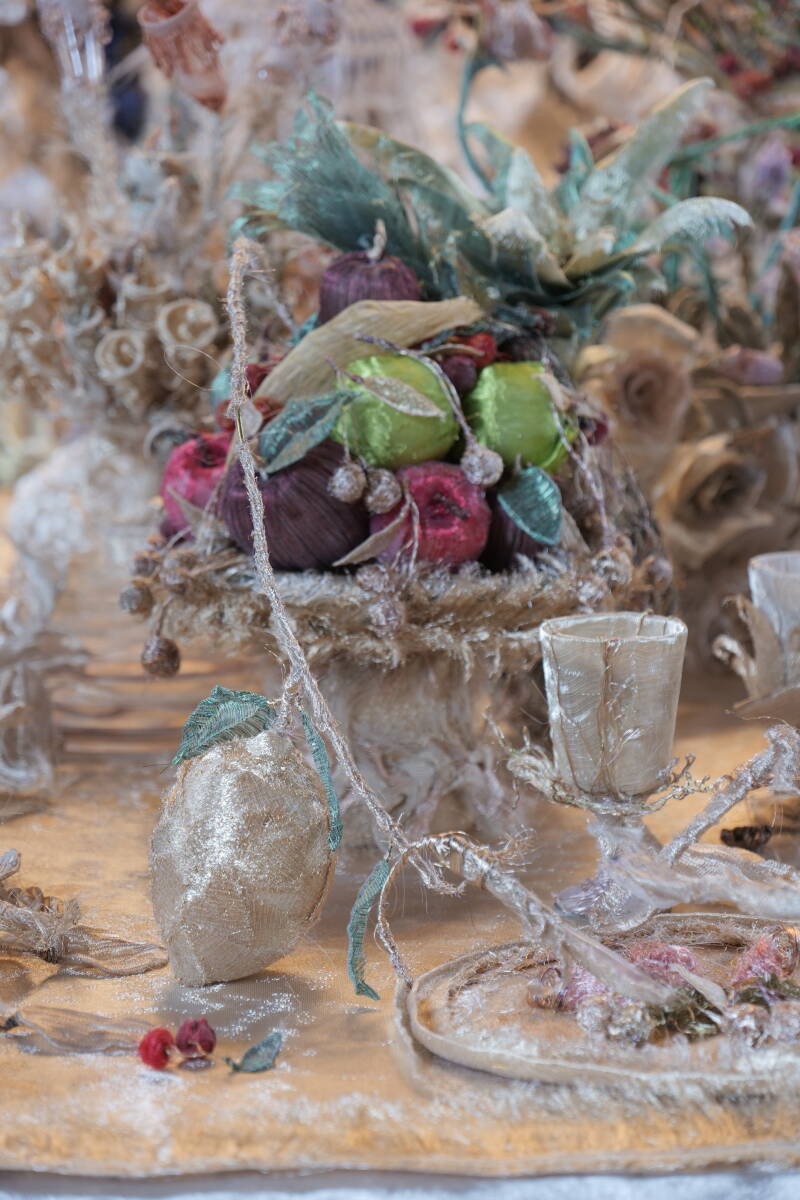
This shift was also visible in richer presentations. At Buccellati, with Aquae Mirabiles, the table was not simply set, but built as a world of silver, glass, reflection and craftsmanship. At Full Metal Banquet by Eric Charles Donatien for LcD Textile Edition in Palazzo Litta, another kind of table scene emerged, with textiles, residual materials, fibres, fruit and flowers. In both cases, the table became more than a carrier of products. It became an image of ritual, material and seduction.
These moments also changed my own way of looking. Milan Design Week is intense and full, with a programme that almost invites you to run in order to capture everything. Yet this year there were strikingly many moments where I stood still for longer, simply to experience. At Alcova, I spent some time inside the Chiesa, where Devices for Connection by Leo Lague and VERSA transformed the former church into a quiet setting of light, sound and technology. Daylight filtered through the stained glass windows, while an LED screen on the floor gave the space a soft glow. It felt like a moment of reflection in the middle of the intensity of the design week.
For brands, makers, importers and product developers, this is an important signal. The value of an object does not lie only in form, colour or finish. That value becomes stronger when the presentation reveals what the product carries: the hand of the maker, the material process, the ritual, the history, the attention or the cultural layer behind it. A product does not only need to be beautifully placed. The presentation needs to make clear why it matters.
The consumer is ultimately not only looking for a new object, but for a sense of authenticity, attention and connection. In a visual culture where everything can be produced quickly, smoothly and convincingly, the trace of presence gains value. A brushstroke, a scent, a sound, a carefully placed floral arrangement or a reference to design history can give a product more meaning.
From staging to presence is therefore not about presenting in a bigger or more exuberant way. It is about presentations that do more than create atmosphere. They reveal where value begins: in the action, the material, the ritual, the scent, the sound or the history of an object. Sometimes this happens in a monumental space, sometimes in a small gesture. The larger image opens the gaze, but the detail gives the story weight.
This observation comes from my Milan Design Week 2026 report. In this digital report, I translate signals from Milan into concrete directions for colour, material, form, surface, space and design language.
The full Milan Design Week 2026 report is now available as a digital edition. On the product page you will find more information, preview images and ordering options.
TH | MILAN DESIGN WEEK 2026 - Report

Milan Design Week 2026 Report
A curated visual and analytical report by trend forecaster Titia Huisman.
Based on on-site observation, photography and design analysis, this 165-page digital report, presented in 83 visual spreads, brings the most relevant signals from Milan Design Week 2026 into clear design direction for interiors, home decor, colour, material, form, styling and collection development.
Not a complete overview. Not a collection of highlights, but a focused reading of the signals that may shape future interiors, materials and collections.
Now available as a digital PDF.
Delivered by email within 24 hours after purchase.

Producten worden niet langer alleen gepresenteerd tegen een mooie of neutrale achtergrond. Ze worden steeds vaker ingebed in omgevingen die iets laten voelen: herkomst, handwerk, ritueel, geschiedenis of materiaalbewustzijn.
Tijdens Milan Design Week 2026 werd zichtbaar hoe presentatie verschuift van styling naar aanwezigheid. Niet alleen door grote installaties, maar juist door momenten waarin een product onderdeel werd van een handeling, een geluid, een geur of een ritueel.
Bij Alcova, in Casa delle Suore, zat Masami Okada voor Atelier Noritake geconcentreerd porselein te beschilderen. Dat beeld bleef hangen omdat het object niet alleen als eindproduct werd getoond. De handeling zelf werd onderdeel van de presentatie. De vaas kreeg tijd, concentratie en aandacht mee, zichtbaar in het oppervlak.
Ook bij Alcova bracht Jose Miguel Schnaider met The Wedding voor Sten Studio zo’n moment samen. De ruimte rook naar honing, kaarsen brandden, bloemen en ornamenten lagen als een zorgvuldig opgebouwd ritueel tussen marmeren objecten. Een vrouw bespeelde een harp in de akoestiek van de ruimte. Daardoor verschoof de aandacht van kijken naar ervaren. Het ging niet alleen om de objecten zelf, maar om geur, geluid, materiaal en ceremonie als onderdeel van dezelfde presentatie.
Bij Galleria Rossana Orlandi lag een zorgvuldig geplaatst bloemenarrangement op de vloer. Een vrouw bewoog er langzaam omheen met een draagbaar klankobject van metalen buizen. Terwijl zij de buizen zacht met een stokje aansloeg, vulden heldere, tingelende tonen de ruimte. Binnen de drukte van de designweek ontstond ineens een kwetsbaar moment van focus. De bloemen functioneerden niet als decoratie, maar als onderdeel van een rituele handeling. Ze verlegden de aandacht van product naar aanwezigheid, van kijken naar voelen en luisteren.
Ook in rijkere presentaties werd deze verschuiving zichtbaar. Bij Buccellati, met Aquae Mirabiles, werd de tafel niet alleen gedekt, maar opgebouwd als een wereld van zilver, glas, reflectie en vakmanschap. Bij Full Metal Banquet van Eric Charles Donatien voor LcD Textile Edition in Palazzo Litta ontstond een ander soort tafelscène, met textiel, restmateriaal, vezels, fruit en bloemen. In beide gevallen werd de tafel meer dan een drager van producten. Ze werd een beeld van ritueel, materiaal en verleiding.
Juist deze momenten veranderden ook mijn manier van kijken. Milan Design Week is intens en vol, met een programma dat bijna uitnodigt om te rennen om alles vast te leggen. Toch waren er dit jaar opvallend veel momenten waarop ik lang bleef staan om te ervaren. Bij Alcova zat ik een tijd in de Chiesa, waar Devices for Connection van Leo Lague en VERSA de voormalige kerk veranderde in een stille omgeving van licht, geluid en technologie. Door de glas-in-loodramen viel daglicht naar binnen, terwijl een LED-scherm op de vloer de ruimte zacht liet oplichten. Het voelde als een moment van bezinning midden in de drukte van de designweek.
Voor merken, makers, importeurs en productontwikkelaars ligt hier een belangrijk signaal. De waarde van een object zit niet alleen in vorm, kleur of finish. Die waarde wordt sterker wanneer de presentatie zichtbaar maakt wat het product draagt: de hand van de maker, het materiaalproces, het ritueel, de geschiedenis, de aandacht of de culturele laag erachter. Een product hoeft niet alleen mooi te worden neergezet. De presentatie moet laten voelen waarom het ertoe doet.
De consument zoekt uiteindelijk niet alleen naar een nieuw object, maar naar een gevoel van echtheid, aandacht en verbondenheid. In een beeldcultuur waarin alles snel, glad en overtuigend kan worden geproduceerd, krijgt juist het spoor van aanwezigheid meer waarde. Een penseelstreek, een geur, een geluid, een zorgvuldig geplaatst bloemenarrangement of een verwijzing naar designgeschiedenis kan een product meer betekenis geven.
From staging to presence gaat daarom niet over groter of uitbundiger presenteren. Het gaat over presentaties die meer doen dan sfeer oproepen. Ze maken zichtbaar waar waarde ontstaat: in de handeling, het materiaal, het ritueel, de geur, het geluid of de geschiedenis van een object. Soms gebeurt dat in een monumentale ruimte, soms in een kleine handeling. Het grote beeld opent de blik, maar het detail geeft het verhaal gewicht.
Deze observatie komt uit mijn Milan Design Week 2026 report. In dit digitale verslag vertaal ik signalen uit Milan naar concrete richtingen voor kleur, materiaal, vorm, oppervlak, ruimte en design language.
Het volledige Milan Design Week 2026 report is nu beschikbaar als digitale editie. Via de productpagina vind je meer informatie, previewbeelden en bestelopties.
Add comment
Comments